Miskatonic University’s investigation of Australian ruins
The Colour Out of SpaceThe Miskatonic University’s investigation of Australian ruins brought a university expedition into the Western Australian desert to examine masonry that appeared to predate known civilization by an immense span of time. Its physical discoveries—especially roughly 1,250 scattered blocks—gave material weight to legends and dream-images that had previously seemed impossible to verify. For Nathaniel Wingate Peaslee, the search became more than an archaeological undertaking: the ruins appeared to meet his own memories across a gulf of time, and an ancient book found among them bore his handwriting.
From correspondence to expedition
The investigation began with reports from Robert B. F. Mackenzie, a mining engineer who had identified ancient blocks in the desert and compared them with the structures described in Peaslee’s published work. Mackenzie described sandstone and granite masonry, as well as one block that appeared to be made from an unusual cement or concrete. Water action had affected the stones, suggesting that the region had been submerged and later emerged. On geological grounds, he judged them to be at least hundreds of thousands of years old, perhaps far older. Their age and markings, he argued, made them possible material foundations for legends of a previously unknown civilization.
Mackenzie proposed that Peaslee lead an archaeological expedition and offered his own help, along with that of Dr Boyle. He was prepared to assemble a dozen miners for heavy excavation. In his letter, he also reported that local Aboriginal people feared the particular site; this information reached Peaslee through Mackenzie’s account and helped define the practical and human circumstances in which the proposed work was framed. The location lay about four days by motor tractor from Pilbarra, roughly 100 miles southeast of Joanna Spring and west and south of Warburton’s 1873 path. Mackenzie also considered moving equipment up the De Grey River. He recommended working during the Australian winter—June, July, or August—because of the tropical climate and difficult desert conditions.
Miskatonic University backed the project, while Mackenzie and Boyle helped arrange its Australian preparations. The organizers kept their aims deliberately general in public, wary that sensational newspapers would turn the search into a joke or spectacle. The expedition’s published footprint was therefore limited: press reports acknowledged a search for reported Australian ruins and some preparations, but not the full significance the participants attached to it.
The journey and the first blocks
The party included Peaslee, his son Wingate, and Professors William Dyer, Ferdinand C. Ashley, and Tyler M. Freeborn. Dyer brought geological expertise and experience leading the Miskatonic Antarctic Expedition of 1930–31; Ashley represented ancient history, and Freeborn anthropology. Mackenzie came to Arkham early in 1935 to assist with final arrangements. The team secured tractors at Pilbarra and chartered a light-draught tramp steamer to travel up the river. Its plan was to excavate carefully, sift the sand, and avoid disturbing objects that appeared to remain in their original positions.
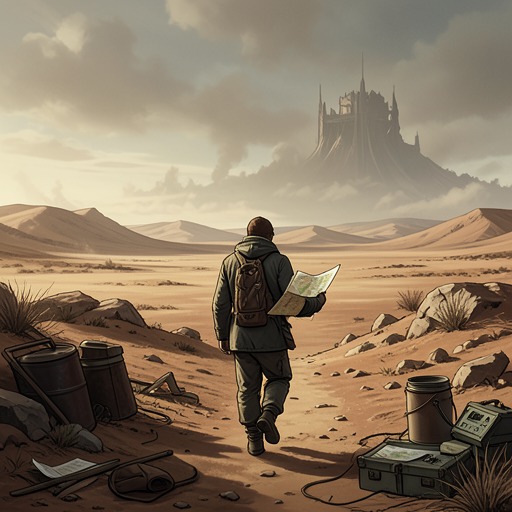
The party sailed from Boston aboard the Lexington on March 28, 1935, crossing the Atlantic and Mediterranean, passing through the Suez Canal, and continuing down the Red Sea and across the Indian Ocean. After reaching Western Australia, the travelers collected their equipment and met Dr Boyle. On May 31, a party of eighteen forded a branch of the De Grey River and entered the desolate country around the site. Peaslee’s unease was heightened by the dreams and apparent memories that had continued to trouble him; the expedition was approaching not only an archaeological location but the landscape he associated with them.
On June 3, the party encountered its first half-buried blocks. Peaslee recognized carved masonry resembling the structures in his dreams, including part of a curved decorative design. The moment mattered because the resemblance was no longer confined to recollection, legend, or published description: he was touching an actual fragment in the ground. The excavation would test that recognition against the physical arrangement and condition of the stones, even as the site refused to yield a simple, complete plan.
Excavation and material findings
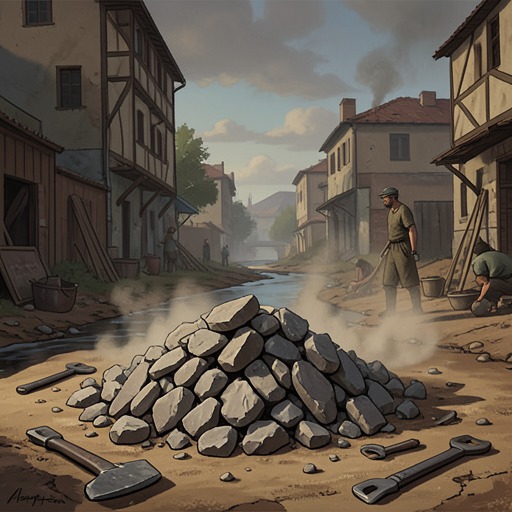
After a month of digging, the team had recovered about 1,250 blocks in differing states of wear and disintegration. Most were carved megaliths with curved upper and lower edges. Others were smaller, flatter, and plain, cut as squares or octagons; their forms recalled the floors and pavements in Peaslee’s dreams. A smaller number were exceptionally massive and curved or slanted, shapes that suggested possible use in vaulting, groining, arches, or round window casings. These variations supplied evidence of architectural forms without allowing the excavators to reconstruct a clear arrangement.
The distribution of the blocks offered another clue, but not a definitive map: more appeared the deeper the team dug and the farther north and east it went. Despite the increasing numbers, the investigators found no trace of an orderly layout. The fragments seemed to have been scattered through a vast span of geological change rather than preserved as an intact building. Their condition and displacement suggested immense time and upheaval, making the site difficult to read through ordinary archaeological expectations of walls, rooms, and successive occupation layers.
The team’s specialists drew different kinds of significance from the same remains. Dyer was struck by the fragments’ extraordinary age. Freeborn identified symbols that seemed to correspond with ancient Papuan and Polynesian legends. Peaslee, meanwhile, saw correspondences between the carved forms and his own recurring dream-images. The expedition thus brought geology, anthropology, ancient history, and personal memory into contact, without making their forms of evidence identical: the blocks could be measured and excavated, while the dreams remained uncertain and subjective.
The ruins and Peaslee’s revelation
The investigation’s importance lay both in what it recovered and in what it could not settle. The blocks supported Mackenzie’s claim that the desert contained remains of an unknown civilization far older than previously imagined, but their scattering prevented a confident reconstruction of the whole. The apparent matches with legends and Peaslee’s dreams widened the interpretive stakes without resolving whether those traditions preserved historical knowledge, whether memory had shaped them, or whether the resemblance had another explanation.
In the later account of his exploration among the buried ruins, Peaslee identifies a discovery that made the connection intensely personal. Inside a metal case, in a forgotten place amid ancient dust, he found a book whose pages appeared to have survived from a time before humanity. Its markings were not unfamiliar prehistoric symbols: they were English words written in Peaslee’s own handwriting. That discovery does not turn the university excavation into a fully documented explanation of the ruins. Instead, it marks the point where archaeological evidence, the narrator’s remembered identity, and the possibility of a history beyond ordinary human chronology converge—while the surviving account still leaves the reality of his experience uncertain.